

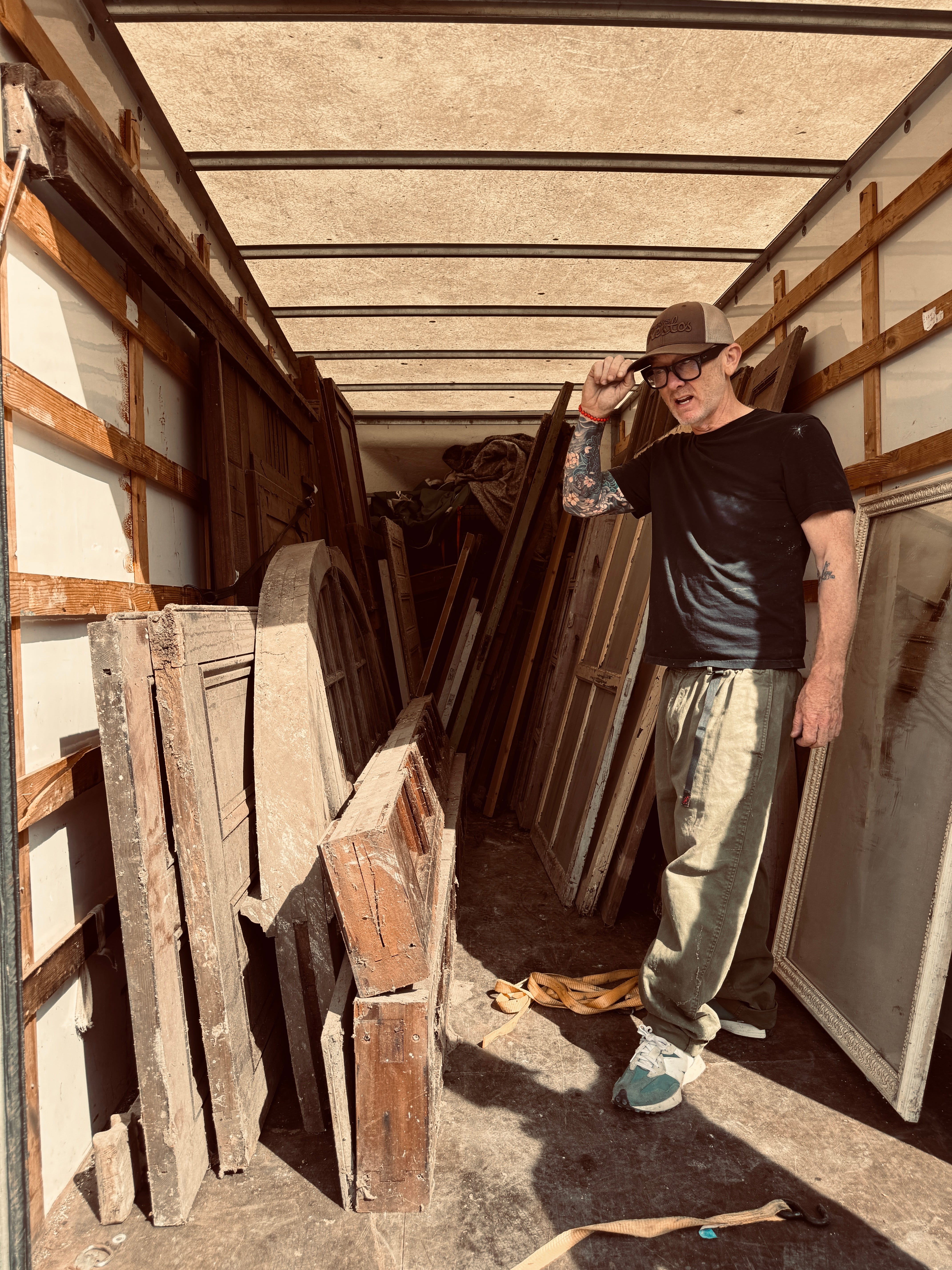
“One man’s junk is now another man’s junk”
I pull up to a sweltering and dusty farm yard, a big one with that oversized gravel that shreds tyres, huge no nonsense single storey stone barns with slate roofs to three sides, two cars are in the yard, an old primer covered landcruiser and a v cool series II landy, both clearly daily work horses. I shut the engine off, turn down the very loud music, “Willie Nelson” btw, ears ringing. It dawns on me, I’ve been doing this for the majority of my adult life, over thirty years, a van, a day of dust and hard work ahead, a lot of potential down sides, but .. and it’s a big but….I’m not bored yet, not one IOTA.
Why not ……you get bored don’t you ? people get bored don’t they.. the same food, music, tv shows… obviously not mine…. you know what I mean, If you have your favourite ice cream every day for a year you’d be fed up of it, right ??…not me.
Architectural salvage, reclamation, architectural antiques, it’s a world I’ve been … well engrossed in for as long as I can remember, but why?. I honestly don't know, I can’t quite put my finger on precisely moment when I became obsessed with the stuff, but read on, it’s the closest I can get to why (for now)… actually it isn’t the complete answer but it’s helping me remember too.
As a child my parents along with the rest of the UK all owned at least one copy of “The Lyle Official Antiques Review” this lump of a book came out annually . My parents religiously bought it and they were lined up on the oak sideboard in the hall.
These thick tomes were full of hand drawn images of the antiques, no photos here, printed roughly a dozen to a page, and it was only in black and white with a brief explanation underneath and a price guide. Now this is the bit I can’t explain, I was drawn like a magnet to these books and would lose hrs of my time digesting them. Here’s the weird bit…I was only interested, no obsessed with the architectural antique section, I lay on the carpet rereading the same pages over and over, a cast iron hob grate or a reeded wrought iron bench, a pitch pine church pew to a stained glass lantern,, I knew the number of every page in every book (still do) and the prices and description off by heart, I particularly loved the cast iron and garden statuary pages, I wasn’t drawn to the sanitary ware (baths and sinks) but I decided I needed to learn all about that too.
Thinking I was limiting myself I did try to spend time absorbing the other categories of my favourite book, ceramics, taxidermy, brassware, toys, carpets, furniture… nothing really interested me, the obsession with architectural antiques grew exponentially.
I began to frequent the outside of a local junk shop, “Terrys bargain store” in Llandudno Junction, a tiny glass fronted two up two down place next to the petrol station, it was a treasure trove, well it wasn’t, but to me this was it. I’d cycle over there, about two miles from home, and just stare through the window…. I never went in, I was too scared. Every few days the window would change, a huge old tv would be replaced by a moth eaten fur coat or an ancient rowing machine, outside leaning under the window would be all manner of flotsum and jetsum, sinks, ironing boards, fireplaces, wheelbarrows, I was utterly enthralled…. I wish I’d gone in, just once.
Once the excitement was over at Terrys I’d wait for “The Old Brickworks”, the local car scrap yard to close, just 100 yds behind “Terrys” as the crow flies. I’d cycle down the rough road and over the railway bridge, if the coast was clear I’d scale the fence, there was an elderly alsatian guard dog in there but I’d worked out that it was too old and tired to jump up and get me if it stayed standing on the cars bonnets, it eventually got bored and went back to its filthy half a car kennel.
These were the days of scrap cars just teetering on top of each other, three maybe four high in places. Below a churned up, oil soaked cocktail of litter batteries, tyres and broken glass, in a mud jui…. Heaven.
My car obsession is still 100 percent active and I know that was something that helped with me “getting my eye in”. Anyway I’d prowl the brick works stock, jumping from one stack to the next, they would rock backwards and forward, I ignored it, this forest of landcrabs and Cortinas, Minis and Volkswagens stacked high like rusty totem poles was my play ground… there was even a pile of XK Jags, unceremoniously dumped on top of each other. This was normal just prior to the classic car boom of the 80s, which I think ruined the hobby..“don’t get me started”, but I digress. I never took anything, nothing, not a thing. Car badges were always the first to go though, these beautiful chromed monkey metal scripts told you exactly what you were getting for your money and they meant what they said, “Zephyr” “Twin cam” “V8”, but I wasn’t there for them, far from it.
I just liked being around all this dereliction, beautiful dereliction…wandering, looking, imagining and just sitting in these old damp wrecks, I was in love with that moment, I still am.
Question,,, When did the normal family mans car become an appliance, these rust buckets used to be rolling art forms, they taught you as they passed, genius designers were behind them, even the most basic models told you everything you needed to know. As a child in the 1970s and early 80s you could still spot E types, Aston Martins and the occasional exotic being used daily, Lagondas etc..morso when on the continent, now that was a real treat.
I know a huge part of my visual education came from staring out of the window at cars. France was the best country for this, the auto routes were full of people travelling here and there on holiday it was a golden era, these old bangers were just cars people used…….to witness a filthy down at heal Citroen DS roll past you in a equally grubby french town was about as exciting as it got for me back then. I knew every model of every car maker and every detail in between, me being me I still remember all these details and will happily bore you to tears if you let me.. A close friend called me the rain man of junk.
One day while it was tipping down at home and I couldn't venture out, I was in my usual spot on the carpet in the living room reading a “LYLE” and was suddenly engulfed by panic, how was I going to learn all this, I can’t ever know all of these dates, styles, periods, the kings and Queens, mahogany or tulipwood, notable births and deaths, what is medieval ?, what was the “Aesthetic Movement” …. aaaaggghhhhh .. I burst into tears, my mum came in to find me wailing on her carpet, “what’s wrong love” … “MUM” I’ll never make it as an antique dealer there’s too much to learn..what am I going to do……………. I was eleven.
Forty five years later I’m sat in my van outside a stone barn on the Scottish Borders.
A couple of weeks prior I had received an intriguing email from an estate owner who in the 1960s had bought the partial contents of a late 18th century mansion built on the banks of the Tweed, “Ladykirk House” as it was being demolished.
“Ladykirk House, Berwickshire, Scotland, built in 1797, designed by Architect William Elliot for the Robertson Family”.

The seller and owner of the estate that these barns are part of had used what he wanted on his project and put the rest away prior to 1966. And there it all had stayed, tidy, uniformly stacked, perfect storage conditions, and untouched by human hand since, this is why I’ve driven for 6 hrs in 33c heat in my frankly disgraceful transit van, that I decided didn’t need air con when I specced it in the Ford showroom which I’ve just remembered stands on the site of the petrol station next to Terry’s…...how odd.. anyway,, cheapskate.
Demolished sometime between 1950 and 1966 this once opulent pile “Ladykirk House” fell victim to demolition as did hundreds of these grand country house after the advent of the two world wars.
The reasons for this once nation wide collection of expansive and opulent “pile of bricks” being demolished on masse were numerous, (higher taxes and death duties, an agricultural depression, the requisitioning of estates during the wars and subsequent damage, the loss of heirs in said conflicts, all this and more had their part to play) the final nail in the Neo-classical coffin happened with the departure of the majority of the domestic staff, “some of these estates had over 100 full time” as they went to serve king and country in WW1 & WW11. Millions didn’t return, the ones that did were not of a mind to serve anymore, ally this to the houses becoming ruinously expensive to maintain (no one clearing the gutters out every day now) and you have the perfect storm.
We lost over 1500 houses, some of real note in the interwar period, hundreds more afterwards, many intentionally burnt down, blown up or even the humiliation of having huge chains placed all the way round the base and then simply pulled down by a multiple of steam and caterpillar driven vehicles, oh the ignominy.
Ladykirk House was one of these losses, set on the north bank of the Tweed near Norham this grand three storied classical mansion was dismantled between 1950 and 1966, these dates do vary depending who you ask.
Bits or as we refer to them in the trade “Architectural elements” of this once grand three storied pile where now on the floor in front of me, like lost shoes.
This is not my first rodeo.
I have been in this situation hundreds of times, it always unleashes the same emotions, excitement for what is left and horror of what has been lost.
The first time this really struck home happened in the same week I set up my business. A local estate agent I’d bought bits through before called me to a very large house in Rhos-on-Sea on the N Wales coast.
This opulent and frankly enormous Edwardian house had latterly become an old folks home, for decades and the new owners wanted to develop it, but called me in prior to see if there was any bounty to be had. There wasn’t, barr the floor boards and a single brass 19th century door pull.
I still have that handle, it was the first piece of architectural salvage I’d bought as a self employed dealer and I had the good sense to keep it as a momento. I put it on the front door of my first house two years later, I now have it downstairs in a box.
Anyway this once grand house I was in, unsurprisingly to anyone local, burnt to the ground a week later, floor boards and all, the developers suddenly had an enormous building plot which they were able to build a few dozen new homes on…. what a stroke of luck… cough…..my eyes were opened to the business I was in.
So I’m faced with an assortment of items, this is normal, some good, some bad, useless and useful in equal measure.
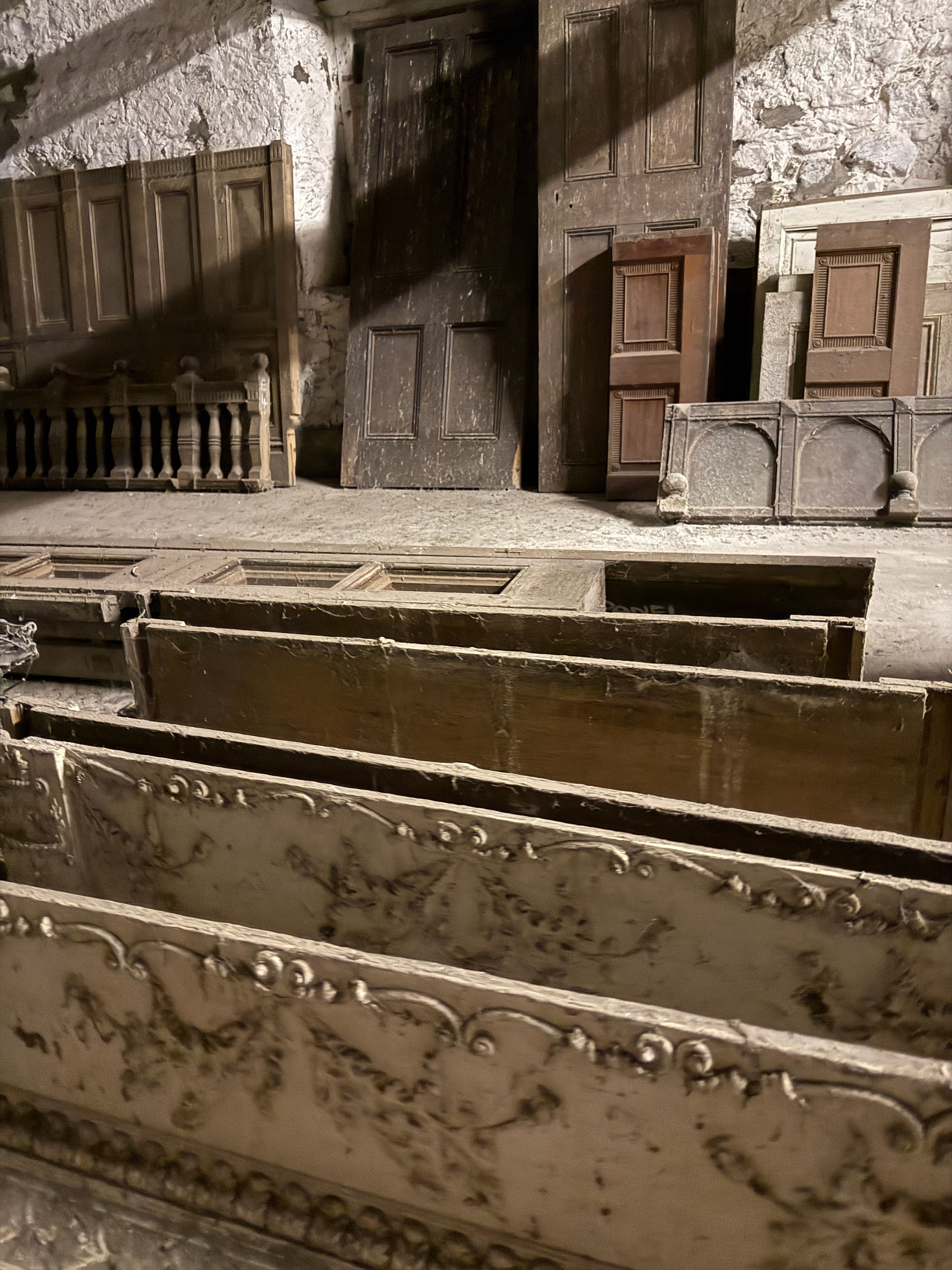
I’m here for a few gems, I visited earlier in the month and put a bid in for the contents, my bid was successful, I paid too much to be honest but I really wanted a couple of things.
There’s an awful lot more in this place than I will be taking away. The price was dependant on me clearing the contents of the barn, good and bad. I’ve called in Rob, long time salvage dealer and local to the barns. He’s a salvage dealer who understands the importance of what we do and he taking everything else away. Robs been doing this and dealing with me since the 90s and knows the job inside out, what’s not to be reused in his current restoration will be sold off to other salvage comrades.
So what am I here for….
1, And the most obvious are eight mostly gilt and some painted gesso over-doors, Neoclassical in style with a few matching pairs interspersed with one real belter, a bucolic country scene in its original gilt decoration.
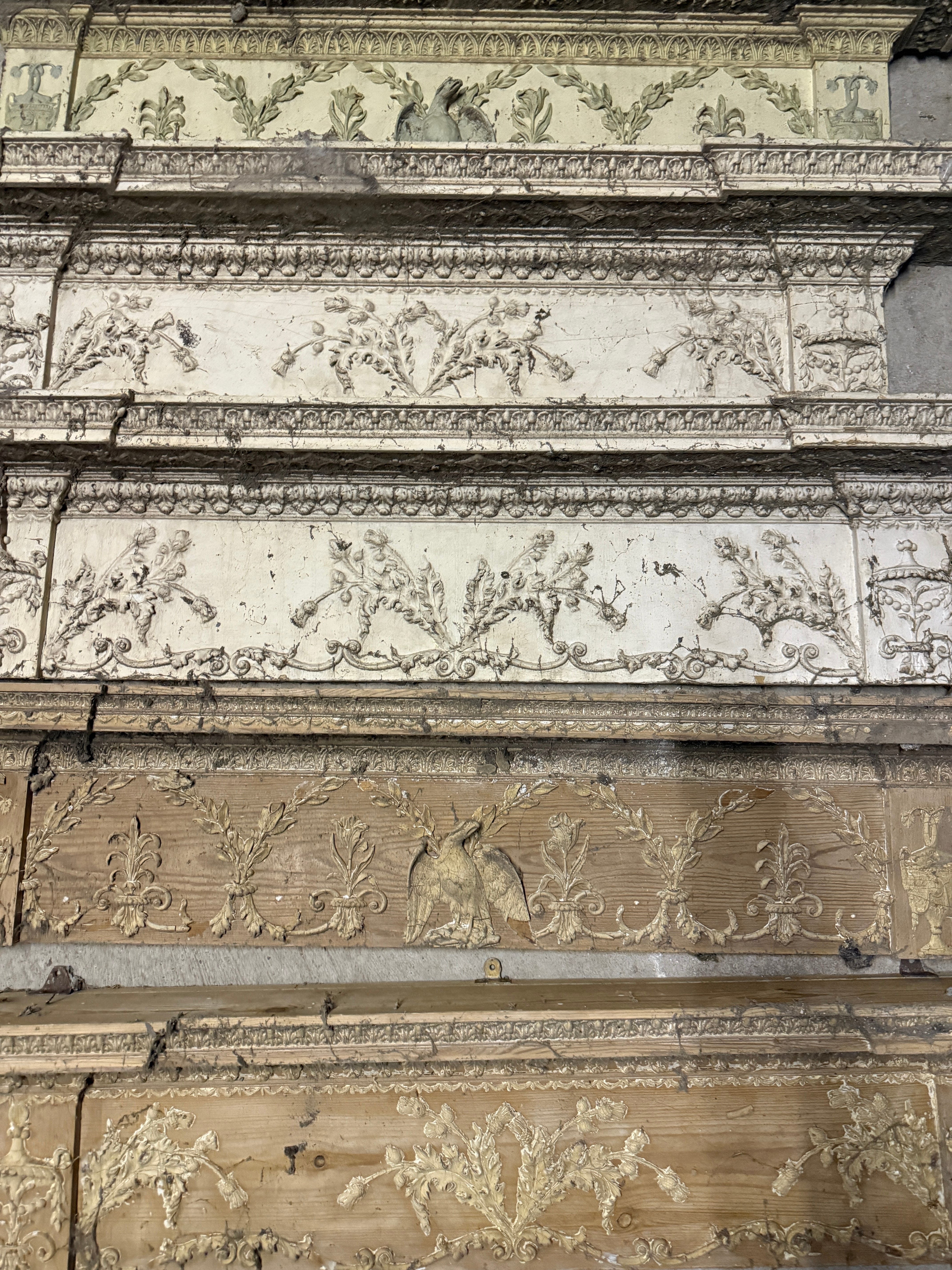
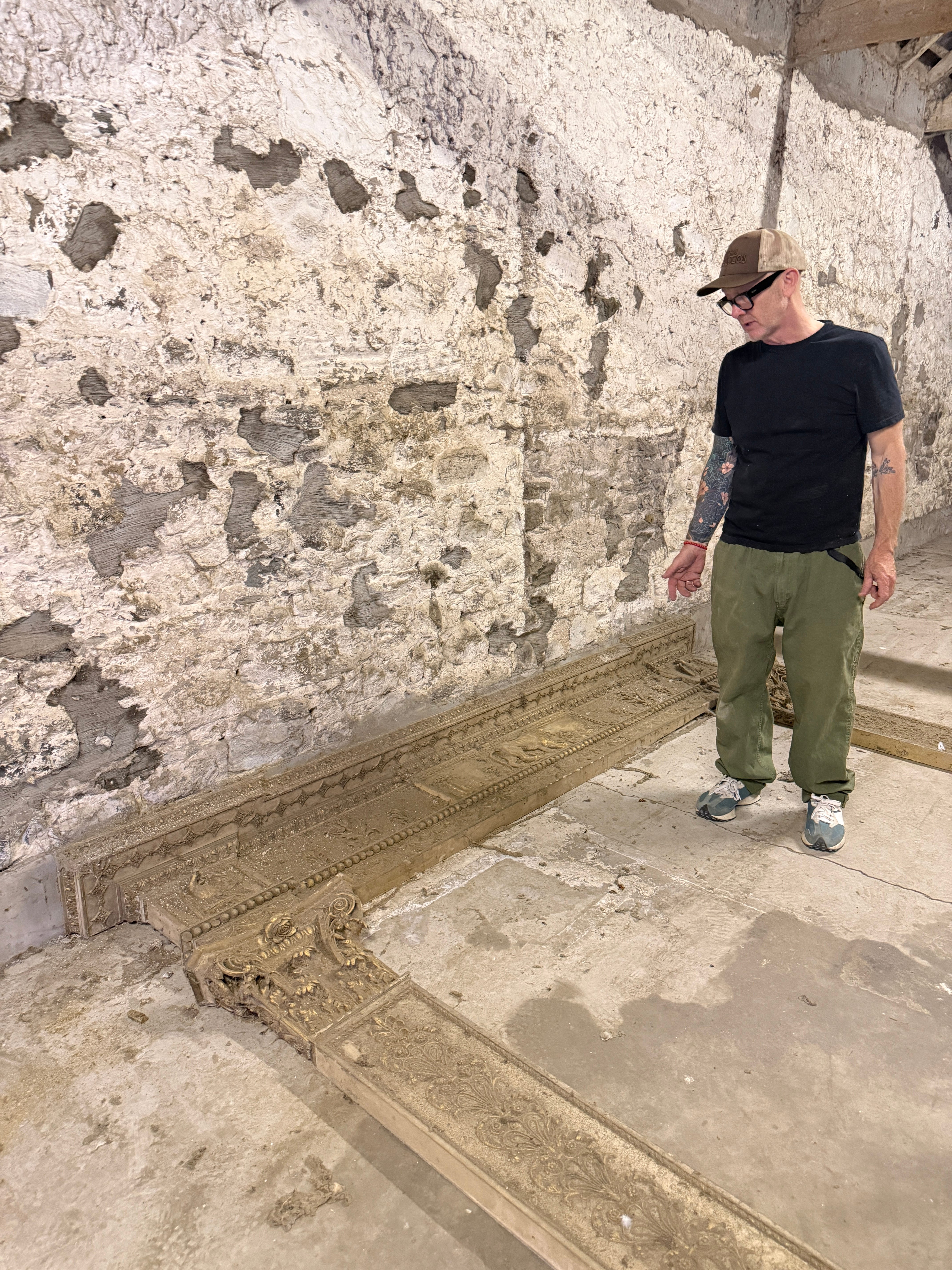
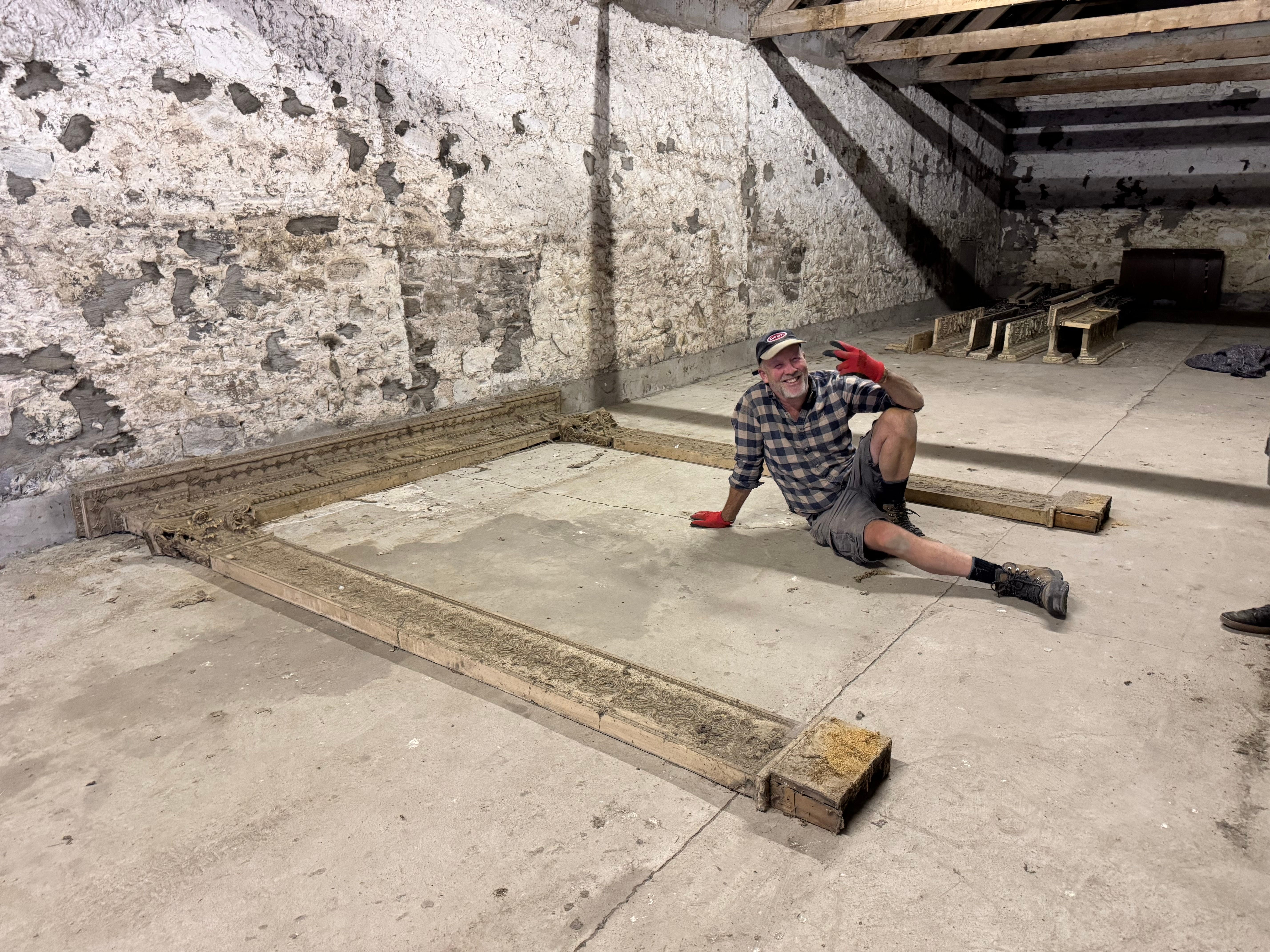
2, A very large chimneypiece or door casing, I say both because I wasn’t allowed to move anything prior to purchase.
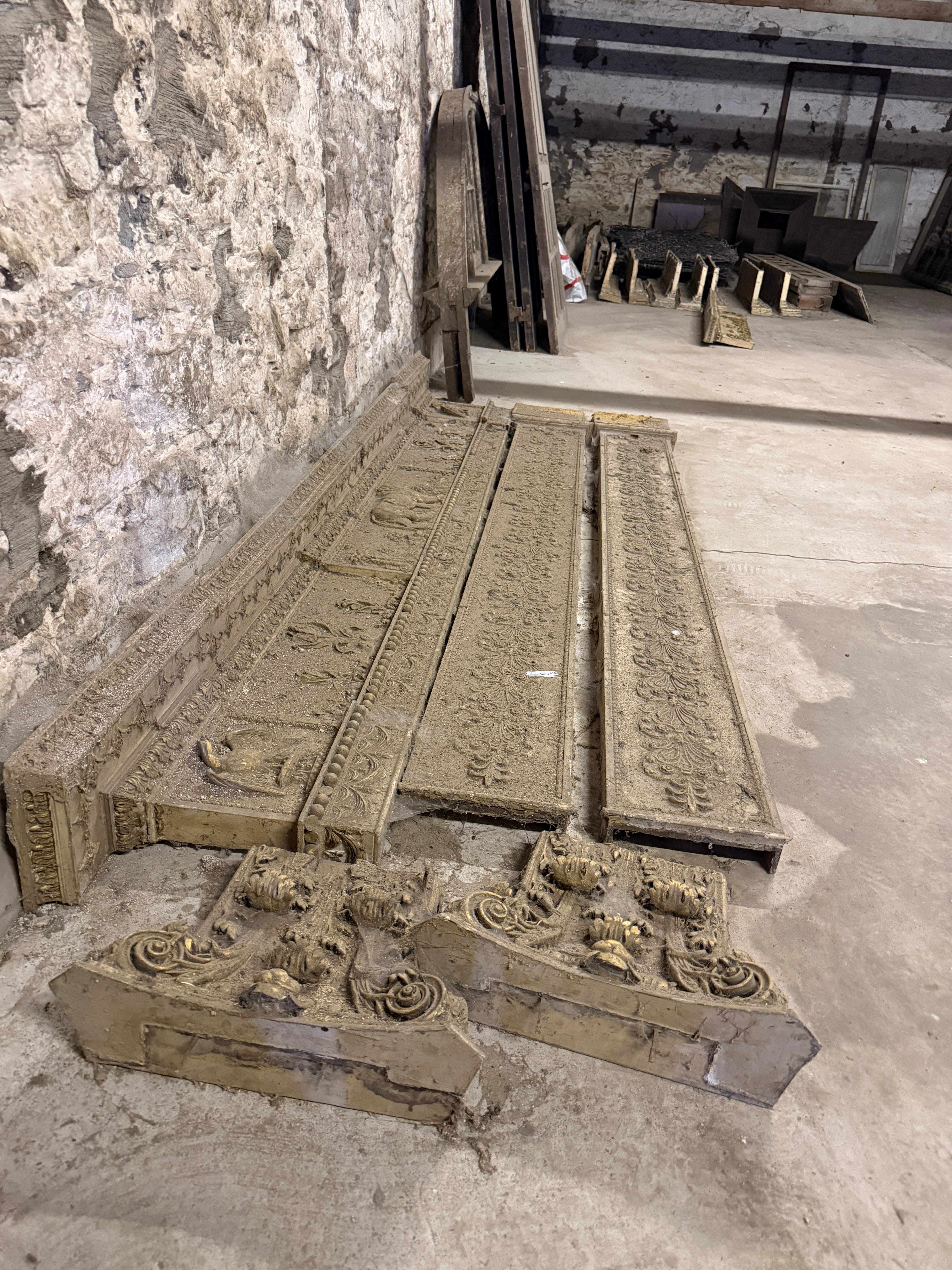
I wanted it to be a chimneypiece, I knew it was a door casing but wouldn’t know for certain till I pulled it all out.
Ok the difference between the two things is obvious but the reason I want it to be a chimneypiece are two fold…
A,
An 18th century chimneypiece is way more desirable and potentially valuable, plus I have numerous clients who would buy it immediately, its also way more exciting in the salvage community to bring one that's been lost from a known house of quality to the market.
B,
A door casing although interesting, and actually rarer to find complete in such incredible condition than a chim is a difficult sell, You either have a doorway or space that will take it or you don’t. Its rarely financially viable to build something that would be big enough to take one this size… but heres the thing, if you do the doorway will add more value to the property than it costs to buy it.. to have it made today would cost you over 20k… thus making it a chancey but potentially brilliant financial decision… “Am I up selling it too much”… anyway its a cool thing and I’m happy to own something so original either way.
3, An 18th century mahogany interior door.
Again I couldn’t move it prior to purchase, I want it to be a thick heavy door of substance, which the side I can see appears to be, once moved its not, it’s a thinner interior door for a large internal room niche or cupboard… bugger, worth a massive amount less than an interior door but on the upside its in mint condition an 18th century.
4, An intriguing box of door furniture, ok so we may have a winner here.
Initial inspection was good, A rare matched pair of brilliant cut and mirrored finger plates with matching handles and escutcheons, result… next numerous pairs of turned laburnum handles, some of these have cut glass handles to one side… why ? I hear you ask, well one side is for the grand interior of a salon, Master bedroom or library at ladykirk, the other side would forever be out of eyeshot of the owner. These plain, workaday handles are for servants eyes and hands only, why spend any money on them aye….
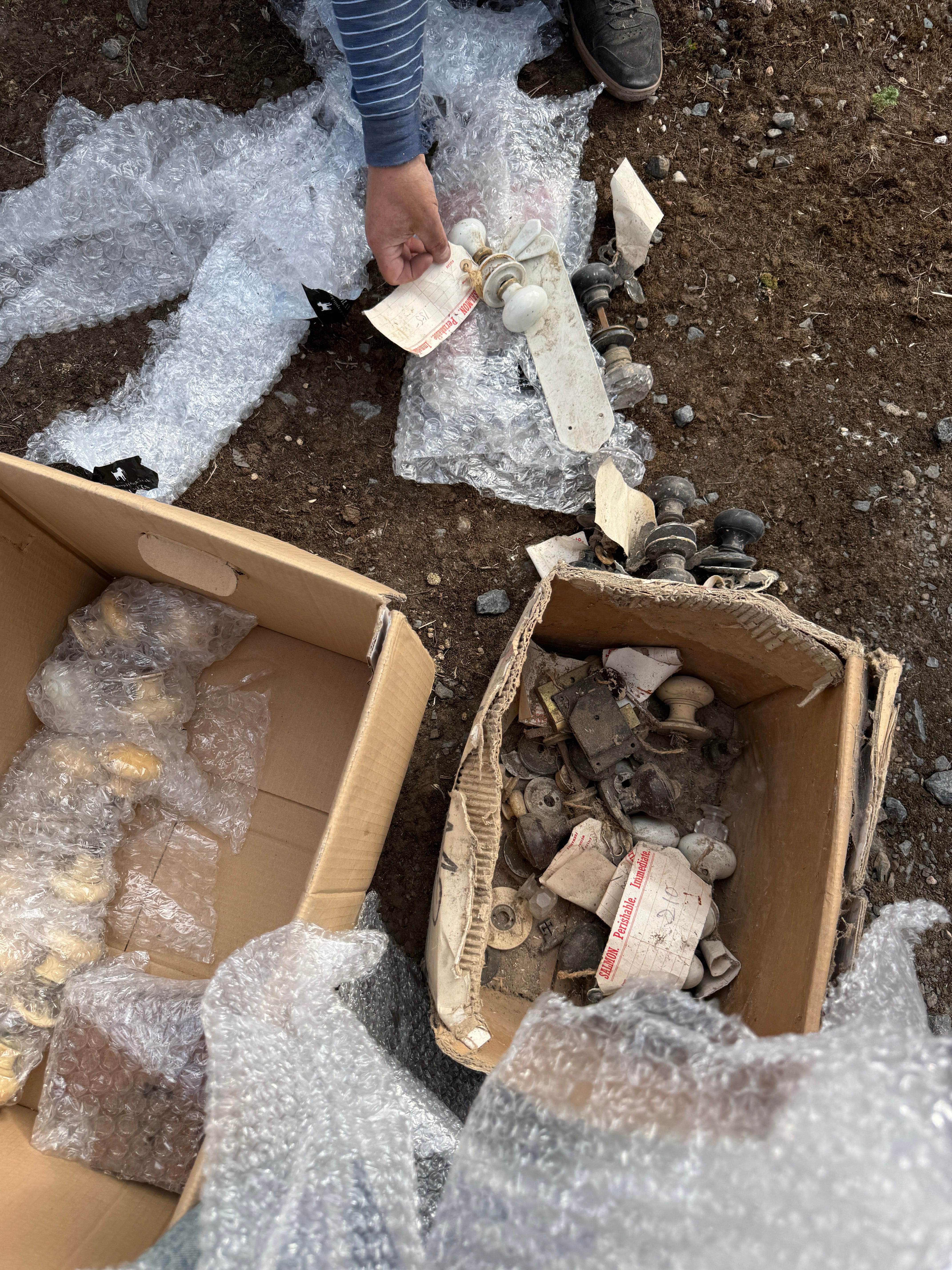
Then I notice something at the bottom of the box, I’ve only ever seen one of these before. A pair of solid turned ivory door handles, and another and another, eight pairs in all, all in perfect condition, complete, undamaged with locks and screws etc etc,,, also completely unsaleable for lots of reasons…
“Under the Ivory Act 2018, the UK enforces a near-total ban on buying, selling, or hiring out items made of or containing ivory, regardless of their age, with very few narrow exemptions requiring official registration or certification beforehand. The ban also covers other species like hippos, walruses, and killer whales, not just elephants”.
I will donating these to an architectural historian friend.
5,
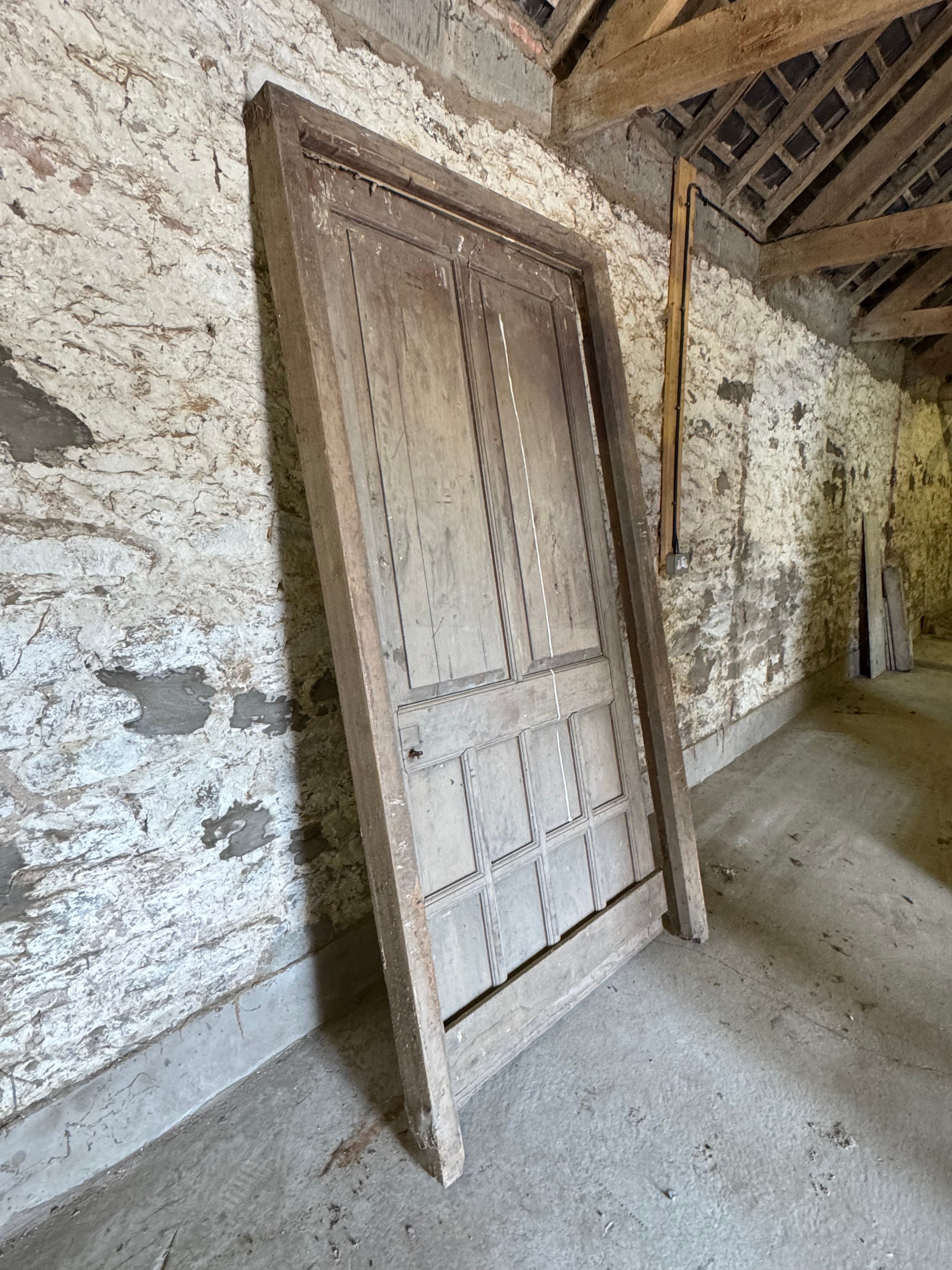
The least exciting but to me the pick of the bunch is a gem of an 18th century pine door and frame.
Ostensibly this is just a door, a pine door, a slightly unusual configuration of lower panels yes, but you know what this thing has…. soul, its had a life, the person who made this understood there craft.
The pine is slow grown and pin straight, no splits, no burrs, the cuts to the timber are flawless, machine like and still tight, the proportion is perfect, mathematically and visually.
It has no airs nor graces, the frame is simple, vernacular, just a full chamfer to all sides, this stuff makes my heart sing.
The simple things in life are always the most beautiful I find, soulful, visually and mentally, the first cup of really good coffee you ever drank, the perfect hue to a late summer morning, “Golden Slumbers” by The Beatles, freshly cooked meatballs in a Sorrento back street, the down shift on a manual six cylinder BMW at full chat… moments of pure joy…you’ll have your own but these are a few of mine.
This door does that to me too, it isn’t shouting, it’s not showing off, it isn’t worth more than a few hundred pounds, it’s not crying for attention, it’s just something created to do a job, the culmination of decades of learning and refining a skill, a deep understanding of the material, and somewhere in there the maker added that magic, he knew if that went this way, and this went that way, it would look just a touch better, and last a bit longer, those subtle nuances, that take decades to learn and are worn in the soul of the maker are all inside a 6ft 8” x 2ft 8” door, I take my hat off to this long gone maestro.
Let me briefly rant…
Look.. if you have well made, correctly proportioned “things” “objects” “anything” around you it rubs off, “and no they really, really don’t need to be expensive”, your brain begins to recognise the symmetry, scale, balance, and thus the beauty in things, this is being eroded by poor design, which has now become acceptable…to some.. this is a huge subject which I’m bound to come back to, but basically, there was a moment when people thought,, “Yup thats, Ok I like that”……………….…lets call it the “Croc” moment.
The world decided at a singular moment that an ugly, unappealing, second rate, badly designed, repulsive piece of footwear that makes you look like a half wit in any situation was acceptable…. the rot had well and truly set it… you can’t learn a damn thing from a Croc, now or in the future. We are going backwards…. the flowing mathematical beauty the Greeks bestowed on us is under attack, a bin fire is raging…... I could weep.
This door and the items I deal in, collect, reuse and have saved every day of my working life, I hope in some small way, are kicking against the onslaught of vulgar ugly throw away rubbish that I watch people buy every day.
Every well meaning and sturdy chapel chair, every polite George III side table or hardy vitreous enamel light shade saved plugs the dam a little more….
So remember this, every time you buy a Tesla, absolutely anything from that big blue and yellow building, a single plastic shoe or decide you want to paint yourself orange, a bit of taste and style and a tiny bit of this antique dealer dies… be warned.
To be continued…
I love the way Drew writes. Not shouty or show offy. Just explains why he enjoys these experiences and why these items are special.
A great read and on the nail re Crocs and Teslas!